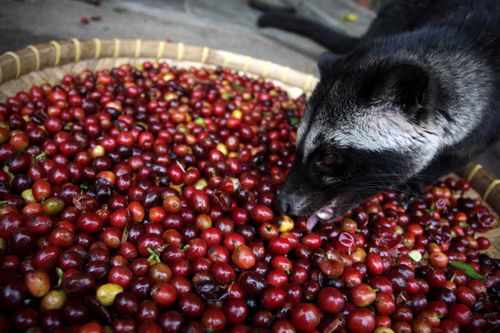
Coffee. Cuppa joe. Brew. Java. The drink that fuels work forces around the world, that wakes people up and brings them together. Made from beans found at the center of red coffee cherries, dried, roasted, ground, sapped by boiling water. This is the basic series of steps for producing that sought-after bitter liquid, but coffee connoisseurs and hipsters could tell you about countless variations on the theme, I’m sure. Usually, that means nuances of which beans to choose from, how long they’re roasted, how finely they’re ground, or how they are steeped then mixed with milk or other flavors. But one coffee requires something special, something that probably can’t be found in any Brooklyn hipster’s kitchen or behind the counter at the fanciest coffee shops you know in most places around the world. This special process has made it a regular top contender for the title of the most expensive coffee in the world: digestion by an Asian palm civet.
You read that correctly. Digestion. All the way in and all the way out. In other words, the coffee is made from civet shit.

Indonesian palm civet cats (they aren’t actually cats, just to be clear; they’re just called that…) prefer to roam coffee groves, selecting the coffee cherries with the richest flavors, bright red and aromatic. It’s not the only food they like to eat, but it is one of their most favored, and certainly the most lucrative. As it turns out, civets are extremely picky with which coffee cherries they’ll consume, only eating the most flavorful if they can help it, making their selectivity one of the two drivers for why coffee made from their excrement is considered such high quality. The other reason is that civet stomach acid partially breaks down the beans at the core of the cherries, balancing out some of the bitterness natural to coffee beans and giving them a slight flavorful overtone that factory-processed coffee has yet to imitate fully, while leaving them mostly intact in bean-form and easy to clean off.

For many connoisseurs, the beans collected from civet droppings, particularly from healthy, wild animals allowed to roam the plantations at will to search for the best cherries, create a flavor unmatched by other coffee selection and processing methods. Plus, the rarity of these “processed” beans drives their prices way higher. As we can all imagine, the marketing of rarity is a very powerful thing, and has driven the trade in luxury goods for millennia.
Civet coffee, or kopi luwak in Bahasa Indonesia (that is, literally, the “language of Indonesia”), is no exception to the trend.

As a result, a normal-size, few-ounce, home-use package of this coffee can cost you between $50 and $100 USD, sometimes even more. A single cup at a cafe can go for $40. A pound of it can go for several hundred US dollars, as seen in the example above. (It’s only true competitor for most expensive coffee in the world is the Hacienda La Esmeralda from Panama, harvested in very small amounts from a grove of coffee plants growing in the shade of guava trees on the mountain of Barú. Either way, unusual tastes plus scarcity equal very lucrative niches in the coffee industry.)
So why am I talking about this bizarrely expensive drink made from civet droppings? Because we accidentally ended up eating lunch near Munduk in central Bali at a coffee plantation specializing in kopi luwak, so we got to see how it’s made and the traditional tools for doing so. This particular site calls itself a Civet Sanctuary as well as a Coffee Plantation. Additionally, it markets an associated restaurant as an Eco Cafe, where they can sell the coffee and food made from produce from a cooperative of local farmers who work on using sustainable practices and supporting local plants and wildlife nearby.
Here’s a look into what we encountered:


Keeping civets captive like this make it a lot easier to gather the valuable droppings to make kopi luwak, of course, but it also affects the quality of life of the civet itself – and can affect the quality of the coffee it helps produce, as the animal has no choice but to be less selective than in the wild, and its stress from being caged affects the chemistry of its digestion, even if it may be mostly well cared for. But for many Indonesian coffee plantations, this is the most efficient way to become involved in the kopi luwak industry, as it’s easier to care for a civet in captivity than to follow them through the wild.
However, it turns out that the cage this civet lived in was far, far bigger and more comfortable than many of the other tiny cages that civets are kept in at coffee plantations elsewhere around Indonesia, which are so small and miserable that animal welfare organizations have mounted campaigns against this practice of the kopi luwak industry. So in contrast to that, this civet, who looked happy to see its caretakers, had a shiny, soft-looking coat, and lots of energy for running around, is probably well cared for, despite still living in a cage. Moreover, we saw our hostess holding the civet and it snuggling around her neck for a few minutes while we ate our meal, so presumably it is so domesticated that it would not be possible to release it safely back into the wild…


And that’s how the (in)famous kopi luwak is made, folks! So after all that, do you think we tried the coffee?

…… Ehhhhh, nope. We were curious, and we knew the beans had been sanitized by the point they are used to make the coffee. But honestly, each cup is so incredibly expensive that we decided that we, who are avid tea drinkers and definitely not coffee connoisseurs, would not be able to taste the subtle differences between kopi luwak and non-civet-digested reasonable-quality coffee… and therefore it was just too much money to spend on a drink. I kind of regret that in retrospect, just to have had the experience, but oh well. At least it was pretty cool to see how the drink was made!
What about you, dear readers? Would you try kopi luwak? Have you ever done so? If so, what did you think?
 E'n'T Adventures: A Travel Blog
Neat story Emmons!
LikeLike
Thanks! By the way, would you have been up for trying out the civet coffee? Since you’re a much more avid coffee drinker than I, I’m curious if you would have thought it worth it to try. 🙂
LikeLike